Fabric denier gets all the spec-sheet attention, but a duffel bag almost never fails because the cloth wore through. It fails at the hardware: a zipper that splits under a stuffed load, a shoulder strap that rips its stitching, a buckle that cracks in the cold. These are the parts that take the force every time the bag is carried, and they are also the parts a decoration-focused quote tends to gloss over. Here is how to specify the zippers, webbing, buckles, and thread so the hardware outlasts the fabric it is attached to.
Zippers: the number is millimeters
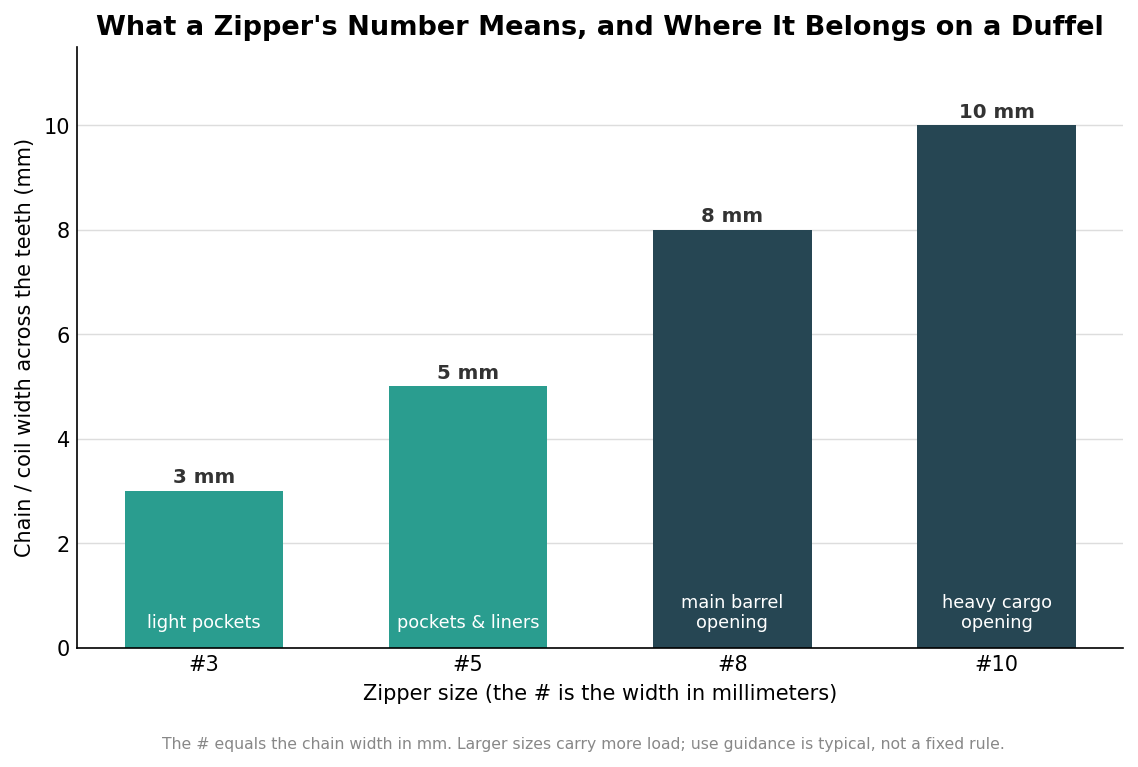
The mysterious number on a zipper, #3, #5, #8, #10, is simply the chain width in millimeters measured across the closed teeth, and bigger means stronger. A #5 is fine for exterior and interior pockets, but the main barrel opening of a duffel that gets crammed full wants a #8 or #10, because that opening carries the load every time someone yanks it shut over an overpacked bag. Then there is the tooth type. Nylon coil is flexible, light, and forgiving around curved openings, and it tends to recover if it is forced. Molded plastic, often sold as Vislon, is stiffer and highly resistant to dirt, corrosion, and UV, which suits outdoor and wet use. Metal is repairable tooth by tooth but can rust and needs more care. For weather, a laminated-tape water-resistant zipper handles splashes, and many stock duffels add a storm flap of fabric over the zipper as a second line of defense rather than relying on the zipper alone. An auto-lock slider that stays put under tension is worth asking for on any bag that will be carried by the handles while full.
Webbing: strength, stretch, and the right width
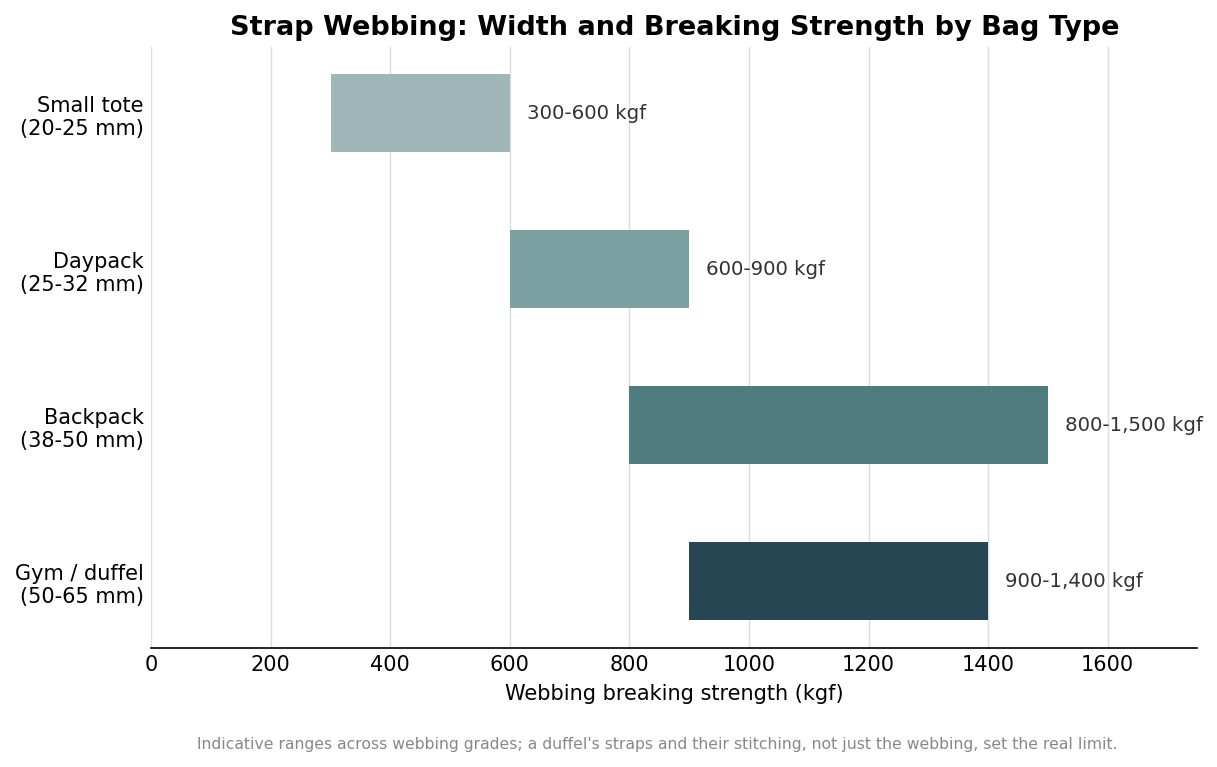
The strap is only as good as its webbing, and the three common materials trade off differently. Nylon is the strongest, roughly 28 to 32 MPa in tensile terms and rated to well over a thousand kilograms-force in heavier grades, but it stretches noticeably, on the order of eighteen to twenty-five percent, and it absorbs a few percent of its weight in water. Polyester gives up a little strength for very low stretch, under five percent, plus strong UV resistance and colorfastness, which is why it holds a bag’s shape and printed logo over time. Polypropylene is the lightest and cheapest, absorbs essentially no water, but is the weakest of the three and best kept to light-duty promotional bags. Width matters as much as material: gym and duffel straps typically run fifty to sixty-five millimeters wide, and wider webbing spreads the load across more stitches at the anchor points. The strap’s breaking strength only means something if the stitching that attaches it can match it, which is the next decision.
Buckles, adjusters, and rings
Side-release buckles and adjusters are usually molded from acetal or nylon, and quality varies more than the identical-looking shapes suggest. A branded-grade acetal buckle holds its adjustment and survives cold better than a bargain buckle that can go brittle and crack in winter, which is a real failure mode for bags that live in car trunks. Metal hardware looks premium and resists cracking but adds weight and can corrode if it is not plated for it. Where a strap is removable or a bag needs lash points, the D-rings and their attachment webbing become load-bearing hardware in their own right, so they deserve the same scrutiny as the main strap rather than being treated as trim. It is also worth confirming the buckle size matches the webbing width, since a buckle sized loosely to its strap slips under load no matter how strong either part is on its own. Specify the hardware grade, not just the color, because the part that fails is rarely the one anyone looked at closely.
Thread and the stitches that hold it together
The strongest strap and the beefiest zipper still depend on thread, and this is the quietest place a duffel is upgraded or cheapened. Bonded nylon thread is the workhorse for bags because the bonding resists abrasion and the needle heat of high-speed machines, and heavier thread at the stress points carries more load per stitch. The critical detail is the bar-tack, the dense back-and-forth stitch that anchors handles, strap ends, and D-ring tabs. A generous bar-tack with enough stitches, placed on reinforced fabric rather than a single layer, is what keeps a handle from peeling the panel open under a heavy load. When you review a sample, the stitching at the anchor points tells you more about how long the bag will last than the fabric weight printed on the tag.
Matching the hardware to the load
Not every bag needs the top of every range, and over-specifying wastes budget. A light promotional or event duffel that carries a change of clothes can run a #5 or small #8 coil zipper, polypropylene or light nylon webbing, and standard buckles without complaint. A team, cargo, or gear duffel that gets thrown in a truck loaded to the seams should step up to a #10 opening, wide nylon or polyester webbing, branded-grade buckles, and reinforced bar-tacked anchor points. Decide which of those two the bag really is before you order, then specify each component to that load: the zipper size, the webbing material and width, the buckle grade, and the stitching at the handles. Get those four right and the fabric denier becomes the least of your worries, because the parts that actually carry the bag were built to carry it.