Custom duffel bags fail their buyers in a predictable way: someone picks a bag because the price and the color look right, prints a logo on it, and only discovers at the gym or the airport that it is too small, too flimsy, or made of a fabric the decoration will not stick to. A duffel is not a generic canvas for your logo; it is a tool with a job, and the job should drive every choice you make. Here is how to match the bag to what it will actually carry.
Start with capacity, and be honest about the trip
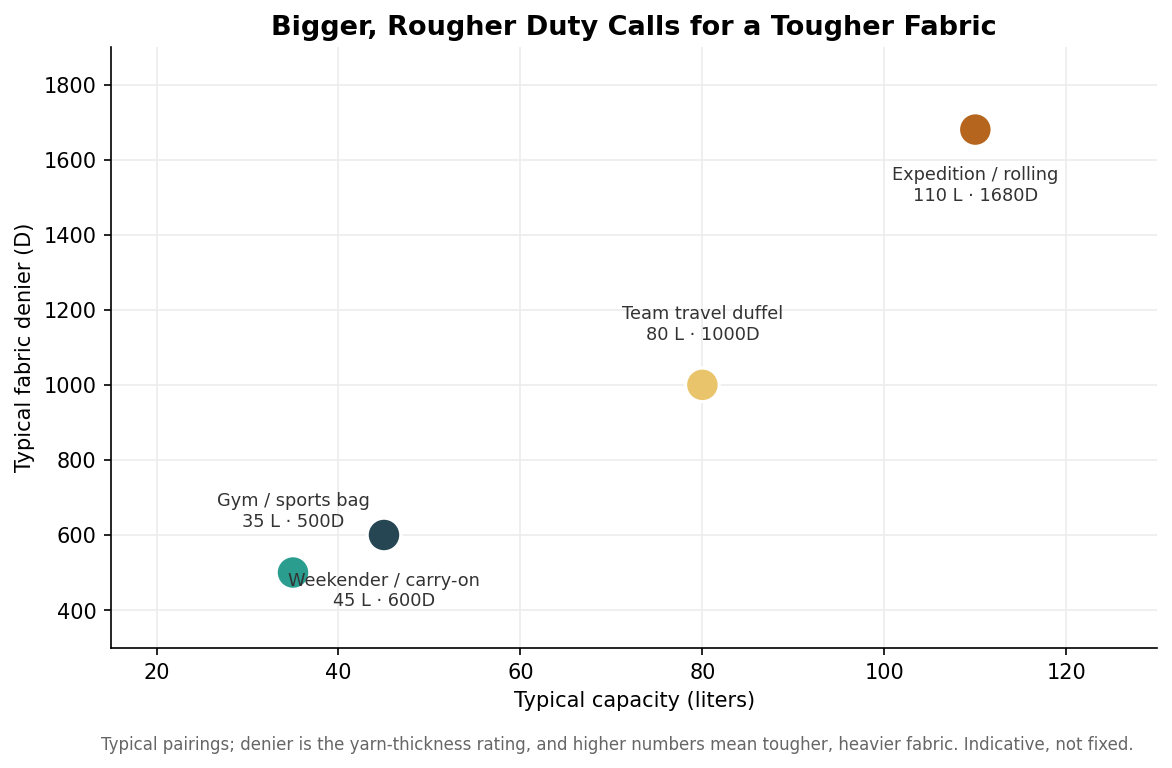
Size is the decision everything else follows from, and buyers almost always guess. Capacity is measured in liters, and the use cases cluster into clear bands. A gym or sports bag lives around 30 to 40 liters, enough for a change of clothes, shoes, and a water bottle without becoming a suitcase. A weekender or carry-on duffel sits around 40 to 45 liters, which is the sweet spot for a two- or three-night trip and, not coincidentally, close to the 22 by 14 by 9 inch carry-on limit most U.S. airlines enforce. A team travel or expedition duffel runs from about 70 liters to well past 100, built for gear hauls and multi-week trips where you are checking the bag anyway. Pick the band that matches the real trip, not the biggest bag on the sheet, because an oversized duffel is heavy, awkward, and tempting to overpack past what your back or the airline will tolerate.
Capacity also tends to track fabric toughness, and it helps to see the two together. Bigger bags carry heavier loads and get dragged across rougher ground, so they are built from heavier fabric. The chart below plots typical capacity against fabric denier, the yarn-thickness rating where higher numbers mean a tougher, heavier cloth.
The gym bag: keep the wet stuff away from everything else
A gym bag’s defining problem is not capacity but contamination: damp towels, sweaty clothes, and dirty shoes sharing one compartment with a clean change and your phone. The features that solve this are worth specifying even on a promotional bag. A separate ventilated shoe or wet pocket keeps the worst offenders isolated, a wipeable or water-resistant lining survives a leaking bottle, and mesh panels let a closed bag air out instead of souring. For fabric, standard 600-denier polyester hits the value-and-durability balance most gym bags want, and lighter 420-denier keeps a budget giveaway affordable. If the bag is a member perk or a resale item rather than a one-day handout, spend the small premium on a real base and a wet pocket; it is the difference between a bag someone keeps and one that ends up in a closet.
The team and travel duffel: capacity plus a bottom that survives
Once a bag is carrying a team’s gear or a fortnight of travel, the failure point moves to the bottom and the zipper. Look for a reinforced bottom panel, ideally in a heavier denier or a doubled layer, because that is the surface that meets gym floors, gravel, and airport carts. A storm flap over the main zipper keeps rain off the coil, and higher-end travel duffels move to 1000-denier nylon such as Cordura for genuine abrasion resistance, with ballistic nylon around 1680 denier reserved for rolling luggage and the roughest use. Recycled fabrics have also become common and capable; a bag built from 600-denier polyester made partly from recycled material can be every bit as tough as a virgin-fiber equivalent, which lets a sustainability message ride along with a functional bag. Grab handles that wrap the full body of the bag, rather than being stitched only to the top panel, spread the load and are far less likely to tear out.
The gift and the weekender: where material becomes the message
For a corporate gift, a client weekender, or a retail piece, the fabric stops being purely functional and starts carrying your brand. Waxed or heavy cotton canvas and vegan or full-grain leather trim read as premium in a way that technical polyester does not, and they photograph beautifully, which matters if the bag is a gift meant to impress. The trade-off is honest weight and less weather resistance than a coated synthetic, so match the material to whether the bag will mostly be admired or actually rained on. On a gift piece, restraint in the branding is usually the right call; a small tonal embroidered mark or a leather patch signals quality, where a large printed logo can make an expensive-feeling bag look like swag.
Getting your logo to last: decoration by fabric
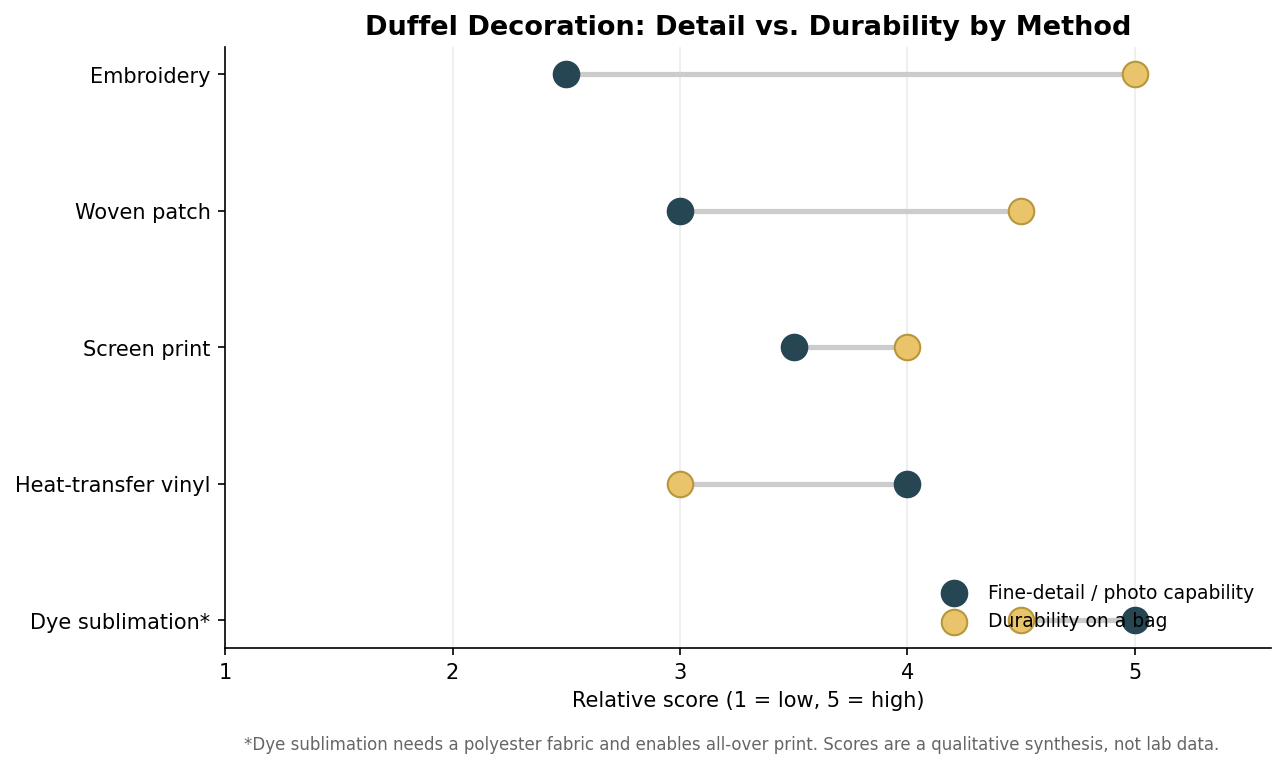
The decoration method has to suit both your artwork and the fabric, and the two do not always agree. Embroidery is the most durable and premium-looking choice and is right for logos and monograms, though it cannot render fine gradients and adds bulk over large areas. A woven or leather patch gives a clean branded mark that survives hard use. Screen printing handles bold, few-color graphics well on flat panels. Heat-transfer vinyl reproduces sharp detail and small text but is the least durable under abrasion. Dye sublimation is the only route to an all-over, edge-to-edge print and can reproduce photographic artwork, but it works only on polyester fabrics, which rules out canvas and leather. The chart below sketches how these methods trade fine detail against durability, so you can pick one that fits both your logo and the bag you have chosen.
Choose the capacity for the real trip, the fabric for the real abuse, and the decoration for both your artwork and that fabric, and a custom duffel becomes what it should be: a bag someone reaches for on purpose, carrying your name because they wanted to bring it, not because it was free.
Leave a Reply